Is the Costco Auto Program Really the Best Way to Buy a Car?

Written By

Peter O'Neil

Published

Jan 19, 2026

Costco buyer reconsidering her decision at the delaership

Learn how the Costco Auto Program works, when it delivers value, and where it falls short. Compare pricing, flexibility, and smarter buying alternatives.

Executive Summary

The Costco Auto Program is widely perceived as a Costco-negotiated car buying service, but in practice it operates as a paid dealer participation and lead-referral program, administered by a third party rather than Costco itself.

Participating dealerships pay to be included, and members who submit a request are routed to a participating dealer, where the transaction follows a traditional dealership sales process with pre-set pricing guidelines.

Because the program is designed around standardized pricing rather than deal optimization, results can vary significantly. Inventory availability, incentives, dealer participation, and deal structure all influence the outcome, while key elements such as lease terms, trade-in value, financing strategy, fees, and regional market conditions typically fall outside the scope of what the program evaluates or negotiates.

The Costco Auto Program leverages brand trust to signal value, but it is not structured to optimize individual transactions. It provides standardized pricing through participating dealers rather than active negotiation. Buyers prioritizing simplicity may find it useful as a reference, while those focused on total cost and deal structure will often need a different approach.


Introduction

The Costco Auto Program connects Costco members with franchised dealerships offering prearranged vehicle pricing. While the program benefits from the Costco brand and its reputation for member value, it is important to understand how the program actually functions behind the scenes.

Costco does not sell vehicles, negotiate individual transactions, or represent buyers in the purchase process. Instead, the program is operated by Affinity Development Group, a third-party company that manages dealer participation and member referrals on Costco’s behalf.

This structure explains both the convenience and the limitations many consumers encounter when using the program.

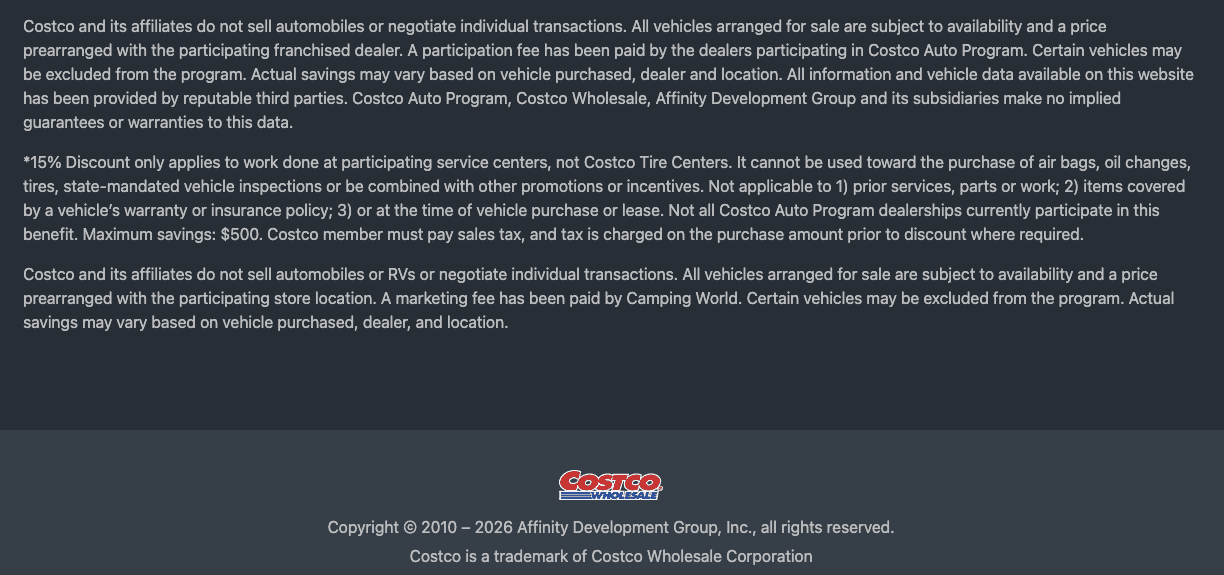
"Costco and its affiliates do not sell automobiles or negotiate individual transactions. All vehicles arranged for sale are subject to availability and a price prearranged with the participating franchised dealer. A participation fee has been paid by the dealers participating in Costco Auto Program. Certain vehicles may be excluded from the program. Actual savings may vary based on vehicle purchased, dealer and location. All information and vehicle data available on this website has been provided by reputable third parties. Costco Auto Program, Costco Wholesale, Affinity Development Group and its subsidiaries make no implied guarantees or warranties to this data."
Costco Auto Disclaimer


How the Costco Auto Program Actually Works

At its core, the Costco Auto Program is built around three fundamental elements:

Pay-to-Participate Dealer Network

Dealers pay a participation fee to be included in the program. Only these dealers are eligible to receive Costco member referrals or offer Costco-arranged pricing.

Lead-Referral Model

When a Costco member submits a request, their information is routed to a participating dealer. From that point forward, the transaction follows a conventional dealership sales process.

Prearranged Pricing

Vehicle prices are pre-set between participating dealers and the program administrator. These prices are not dynamically optimized for individual buyers, market timing, or deal structure.

Costco itself does not negotiate, verify, or guarantee that the pricing represents the best possible outcome in a given market.

Who Operates the Program: Understanding Affinity Development Group

Affinity Development Group is the company that operates the Costco Auto Program on Costco’s behalf. ADG specializes in affinity-based automotive programs and runs similar initiatives for credit unions and other membership organizations nationwide.

Its core business model centers on lead generation and dealer participation, rather than buyer representation or deal advocacy. While the Costco name provides trust and visibility, the buying experience itself is shaped by ADG’s program structure and participating dealers.

Understanding this distinction helps explain why the program prioritizes simplicity and scale over individualized negotiation.


Costco Member Incentives Are Separate From the Auto Program

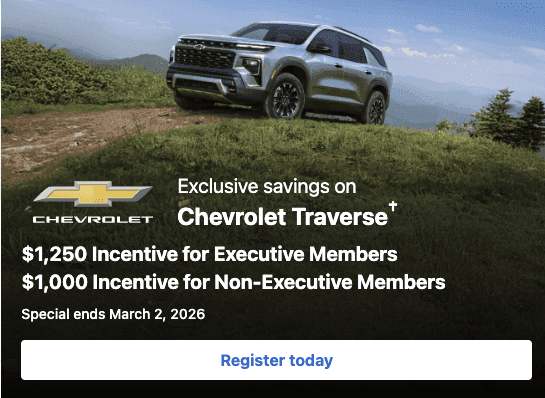
Occasionally, certain manufacturers offer special incentives or rebates for Costco members, such as limited-time cash allowances or finance-related benefits. These offers are often marketed alongside the Costco Auto Program, which can create the impression that they are exclusive to purchasing through the program itself.

In practice, these incentives are typically manufacturer-sponsored, not dealer-negotiated, and separate from the Costco Auto Program’s pricing structure.

In many cases, eligible buyers can still claim a Costco member incentive even if they:

• Purchase directly from a dealership outside the Costco Auto Program, or

• Work with a licensed auto broker or alternative buying service

As long as the buyer meets eligibility requirements — such as having an active Costco membership and registering or verifying their membership as required by the manufacturer — the incentive may still apply.


Chevrolet Costco member incentive


Why This Distinction Matters

Confusing Costco member incentives with Costco Auto Program pricing can lead buyers to overestimate the value of the program itself.

The incentive:

• Is typically set by the manufacturer

• Applies regardless of how the vehicle price is negotiated

• Can often be combined with other pricing strategies

The Costco Auto Program:

• Provides standardized, prearranged pricing

• Does not control manufacturer incentives

• Does not optimize how incentives are applied within a broader deal structure

Understanding this distinction helps buyers focus on total transaction value, rather than assuming the program is required to access every Costco-related benefit.


Pros and Cons of the Costco Auto Program

Pros

Simplified pricing experience
Prearranged pricing can reduce the stress of initial price negotiations and provide a clearer starting point for buyers.

Wide availability
The program is available nationwide and accessible to Costco members in all 50 states.

Convenience
For buyers who prefer a streamlined introduction to a dealership without extended negotiation, the process can feel straightforward and efficient.

Cons

Limited negotiation support
The program does not actively assist with trade-in valuation, lease-versus-buy analysis, financing strategy, or dealer add-ons.

Lack of deal optimization
Pricing is standardized rather than tailored to market conditions, incentives, or individual buyer leverage.

Dealer-dependent experience
Final outcomes depend heavily on the specific dealership handling the referral, including how closely pricing guidelines are followed and how additional products are presented.

The program trades flexibility and advocacy for simplicity.


Key Considerations for Car Buyers

Before choosing any auto buying program, consumers should evaluate more than just the advertised vehicle price.

Important questions include:

• Are lease terms and financing options reviewed holistically?

• Is trade-in value negotiated independently of the vehicle purchase?

• Are dealer add-ons and ancillary products actively evaluated or negotiated?

• How transparent is the process around fees and financing markups?

Programs that address these factors comprehensively tend to have a greater impact on total cost of ownership, not just the initial purchase price.


How a Full-Service Auto Broker Differs

Some buyers choose to work with licensed auto brokers who operate under a different model than lead-referral programs.

For example, CarOracle operates as a licensed auto broker in California, providing end-to-end assistance that can include:

• Negotiating vehicle pricing and incentives across multiple dealers

• Managing trade-in valuation independently

• Structuring lease or financing terms

• Evaluating optional products and dealer fees

• Coordinating paperwork and delivery

These experiences often stem from expectations that the program will deliver full-service negotiation, which it is not designed to provide.

What Customer Feedback Suggests


Publicly available customer feedback on the Costco Auto Program often reflects the program’s structure and limitations.

Many users appreciate that the program eliminates initial haggling.

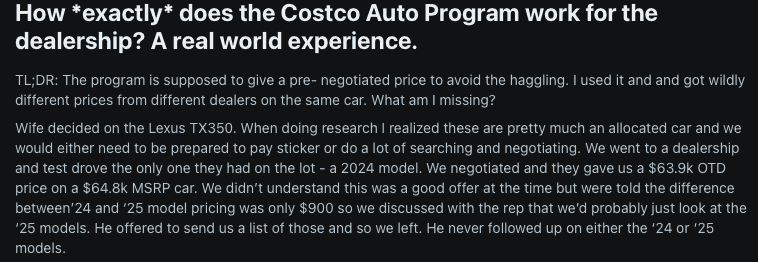
However, other buyers report varied experiences with pricing outcomes and dealer behavior that mirrors traditional sales negotiations more than an optimized deal. One user noted they received “wildly different prices from different dealers on the same car,” suggesting that the referral network and dealer practices can outweigh the benefit of standardized pricing. 
Reddit User


These real-world accounts reflect the mixed nature of user experiences — simplified pricing and reduced friction for some, and uneven dealer execution or limited optimization for others.

These experiences often stem from expectations that the program will deliver full-service negotiation, which it is not designed to provide.

Making an Informed Choice

The Costco Auto Program can be a useful option for buyers who prioritize convenience, predictability, and minimal negotiation.

Buyers who place greater emphasis on deal structure, total transaction cost, and personalized advocacy may benefit from exploring alternatives that offer deeper involvement in the buying process.

Understanding how each model works allows consumers to choose the approach that best aligns with their priorities, risk tolerance, and desired level of involvement.


FAQs (Frequently Asked Questions)

What are the main benefits of using the Costco Auto Program for car buyers in California?

Key benefits include access to pre-negotiated pricing that can lead to potential savings and a national footprint allowing members across all 50 states to participate. The program simplifies the car buying process by connecting members with dealers who have paid a participation fee to offer these deals.

What limitations should consumers be aware of when using the Costco Auto Program?

Consumers may face limited negotiation scope within the program, including minimal support for trading in or selling existing vehicles, evaluating lease versus buy options, and handling additional dealer add-ons like extended service contracts or maintenance programs. The program also excludes certain vehicles and actual savings can vary based on dealer and location.

How does CarOracle differ from the Costco Auto Program as an alternative in California?

CarOracle is a licensed full-service auto broker offering personalized assistance throughout the car buying process. Unlike the Costco Auto Program, CarOracle provides comprehensive services including trade-in negotiations, securing competitive financing terms, and tailored support, which can result in a more customized and potentially advantageous car buying experience for consumers in California.

Why should consumers consider ancillary product negotiations and financing terms when choosing an auto program?

Evaluating ancillary products such as warranties and maintenance plans is crucial because these add-ons impact overall ownership costs. Additionally, securing competitive financing terms can significantly influence total expenses over time. Programs like CarOracle may offer better negotiation support in these areas compared to more limited offerings like the Costco Auto Program.

What do customer reviews reveal about experiences with the Costco Auto Program?

Customer feedback on the Costco Auto Program is mixed; some users appreciate the convenience and pre-negotiated pricing while others highlight limitations such as lack of personalized negotiation support and restricted service offerings. These varied experiences suggest that consumers should carefully assess their individual needs before choosing between the Costco Auto Program and alternatives like CarOracle.

ON THIS PAGE

Smart Shopper Insights FAQs

What should I look for during a pre-purchase inspection?

A pre-purchase inspection should cover the vehicle's mechanical condition, appearance, and safety features. On the exterior, look for signs of damage or rust, and inside, check for wear and tear, and the condition of the tires. Under the hood, look for any signs of leaks, the condition of hoses and belts, and the state of the fluids. Ideally, a trusted mechanic should conduct a comprehensive inspection, including putting the vehicle on a lift to check the undercarriage, suspension, and to detect any potential leaks or undisclosed damage from an accident. They should also inspect the engine, transmission, brakes, and steering systems, verify the function of warning lights, and take note of any that come on after starting the engine. Finally, a test drive is an essential step to evaluate the car's handling, braking, and overall performance.

What should I look for during a pre-purchase inspection?

A pre-purchase inspection should cover the vehicle's mechanical condition, appearance, and safety features. On the exterior, look for signs of damage or rust, and inside, check for wear and tear, and the condition of the tires. Under the hood, look for any signs of leaks, the condition of hoses and belts, and the state of the fluids. Ideally, a trusted mechanic should conduct a comprehensive inspection, including putting the vehicle on a lift to check the undercarriage, suspension, and to detect any potential leaks or undisclosed damage from an accident. They should also inspect the engine, transmission, brakes, and steering systems, verify the function of warning lights, and take note of any that come on after starting the engine. Finally, a test drive is an essential step to evaluate the car's handling, braking, and overall performance.

What should I look for during a pre-purchase inspection?

A pre-purchase inspection should cover the vehicle's mechanical condition, appearance, and safety features. On the exterior, look for signs of damage or rust, and inside, check for wear and tear, and the condition of the tires. Under the hood, look for any signs of leaks, the condition of hoses and belts, and the state of the fluids. Ideally, a trusted mechanic should conduct a comprehensive inspection, including putting the vehicle on a lift to check the undercarriage, suspension, and to detect any potential leaks or undisclosed damage from an accident. They should also inspect the engine, transmission, brakes, and steering systems, verify the function of warning lights, and take note of any that come on after starting the engine. Finally, a test drive is an essential step to evaluate the car's handling, braking, and overall performance.

What does a rebuilt title or branded title mean?

A rebuilt or branded title indicates that a vehicle has suffered significant damage in the past and was deemed a total loss by an insurance company. This damage might have been due to a collision, flood, or other serious incidents. After the damage, the vehicle was repaired and inspected to ensure it met certain roadworthiness standards. However, understanding the extent of the damage and the quality of repairs is vital as structural deficiencies can be challenging to detect with a visual inspection alone. A branded title can significantly affect a vehicle's value and its potential for future resale. Therefore, it's vital to thoroughly inspect and understand a vehicle's repair history before making a purchase.

What does a rebuilt title or branded title mean?

A rebuilt or branded title indicates that a vehicle has suffered significant damage in the past and was deemed a total loss by an insurance company. This damage might have been due to a collision, flood, or other serious incidents. After the damage, the vehicle was repaired and inspected to ensure it met certain roadworthiness standards. However, understanding the extent of the damage and the quality of repairs is vital as structural deficiencies can be challenging to detect with a visual inspection alone. A branded title can significantly affect a vehicle's value and its potential for future resale. Therefore, it's vital to thoroughly inspect and understand a vehicle's repair history before making a purchase.

What does a rebuilt title or branded title mean?

A rebuilt or branded title indicates that a vehicle has suffered significant damage in the past and was deemed a total loss by an insurance company. This damage might have been due to a collision, flood, or other serious incidents. After the damage, the vehicle was repaired and inspected to ensure it met certain roadworthiness standards. However, understanding the extent of the damage and the quality of repairs is vital as structural deficiencies can be challenging to detect with a visual inspection alone. A branded title can significantly affect a vehicle's value and its potential for future resale. Therefore, it's vital to thoroughly inspect and understand a vehicle's repair history before making a purchase.

Are service records really that important when looking at a used car?

Absolutely, service records are crucial when considering a used vehicle. They provide a detailed history of the maintenance and repairs the car has undergone, giving insight into how well it has been taken care of. Regular maintenance not only improves a vehicle's performance but also extends its life. Observing diligent maintenance intervals also offers insight into the previous owner's responsibility and commitment to vehicle upkeep. If a vehicle lacks service records, it might be challenging to determine its actual condition and if critical maintenance tasks were performed as needed.

Are service records really that important when looking at a used car?

Absolutely, service records are crucial when considering a used vehicle. They provide a detailed history of the maintenance and repairs the car has undergone, giving insight into how well it has been taken care of. Regular maintenance not only improves a vehicle's performance but also extends its life. Observing diligent maintenance intervals also offers insight into the previous owner's responsibility and commitment to vehicle upkeep. If a vehicle lacks service records, it might be challenging to determine its actual condition and if critical maintenance tasks were performed as needed.

Are service records really that important when looking at a used car?

Absolutely, service records are crucial when considering a used vehicle. They provide a detailed history of the maintenance and repairs the car has undergone, giving insight into how well it has been taken care of. Regular maintenance not only improves a vehicle's performance but also extends its life. Observing diligent maintenance intervals also offers insight into the previous owner's responsibility and commitment to vehicle upkeep. If a vehicle lacks service records, it might be challenging to determine its actual condition and if critical maintenance tasks were performed as needed.

AutoCheck vs. CarFax: Is one better than the other?

Both AutoCheck and CarFax provide detailed information about a vehicle's history, though they source their data differently. CarFax is known for its comprehensive service and maintenance records and is extensively used by dealerships. In contrast, AutoCheck, owned by Experian, uses a unique scoring system that helps buyers understand a vehicle's condition at a glance. Depending on your specific needs and the level of detail you're looking for, you might prefer one over the other.


AutoCheck vs. CarFax: Is one better than the other?

Both AutoCheck and CarFax provide detailed information about a vehicle's history, though they source their data differently. CarFax is known for its comprehensive service and maintenance records and is extensively used by dealerships. In contrast, AutoCheck, owned by Experian, uses a unique scoring system that helps buyers understand a vehicle's condition at a glance. Depending on your specific needs and the level of detail you're looking for, you might prefer one over the other.


AutoCheck vs. CarFax: Is one better than the other?

Both AutoCheck and CarFax provide detailed information about a vehicle's history, though they source their data differently. CarFax is known for its comprehensive service and maintenance records and is extensively used by dealerships. In contrast, AutoCheck, owned by Experian, uses a unique scoring system that helps buyers understand a vehicle's condition at a glance. Depending on your specific needs and the level of detail you're looking for, you might prefer one over the other.


Are autobrokers the equivalent of real estate agents?

Auto brokers and real estate agents both serve as intermediaries in their respective fields, offering similar services that streamline and facilitate transactions for buyers. Here's a closer look at the parallels:

  • Advocacy and Representation: Both professionals advocate for your interests, finding options that match your preferences and budget.

  • Negotiation Skills: They negotiate terms on your behalf to secure advantageous deals, from price to financing.

  • Market Insight: With specialized knowledge of their markets, they guide you to make informed decisions.

  • Time-Saving: They manage the complexities of transactions to save you time and effort.

  • Compensation Structure: In many cases, just like real estate agents, auto brokers' fees are paid by the seller, which means their services can often come at no direct cost to the buyer.

An important distinction to note is the regulatory environment. In California, auto brokers are required to have a dealer license issued by the state, similar to real estate agents who must be licensed to operate. This ensures that they adhere to stringent standards of professionalism and ethical conduct, undergo thorough background checks, and comply with specific transaction codes that govern vehicle sales within the state. While the same level of regulation may not apply to auto brokers in other states, many still operate with a strong commitment to honesty and transparency.

When you work with a licensed auto broker in California, you're engaging with a professional who has met all the necessary requirements to legally and ethically conduct car sales, akin to the rigorous process real estate agents go through for licensure. This not only underscores the credibility of the broker but also provides you with added assurance that your transaction adheres to all state laws and regulations.

Are autobrokers the equivalent of real estate agents?

Auto brokers and real estate agents both serve as intermediaries in their respective fields, offering similar services that streamline and facilitate transactions for buyers. Here's a closer look at the parallels:

  • Advocacy and Representation: Both professionals advocate for your interests, finding options that match your preferences and budget.

  • Negotiation Skills: They negotiate terms on your behalf to secure advantageous deals, from price to financing.

  • Market Insight: With specialized knowledge of their markets, they guide you to make informed decisions.

  • Time-Saving: They manage the complexities of transactions to save you time and effort.

  • Compensation Structure: In many cases, just like real estate agents, auto brokers' fees are paid by the seller, which means their services can often come at no direct cost to the buyer.

An important distinction to note is the regulatory environment. In California, auto brokers are required to have a dealer license issued by the state, similar to real estate agents who must be licensed to operate. This ensures that they adhere to stringent standards of professionalism and ethical conduct, undergo thorough background checks, and comply with specific transaction codes that govern vehicle sales within the state. While the same level of regulation may not apply to auto brokers in other states, many still operate with a strong commitment to honesty and transparency.

When you work with a licensed auto broker in California, you're engaging with a professional who has met all the necessary requirements to legally and ethically conduct car sales, akin to the rigorous process real estate agents go through for licensure. This not only underscores the credibility of the broker but also provides you with added assurance that your transaction adheres to all state laws and regulations.

Are autobrokers the equivalent of real estate agents?

Auto brokers and real estate agents both serve as intermediaries in their respective fields, offering similar services that streamline and facilitate transactions for buyers. Here's a closer look at the parallels:

  • Advocacy and Representation: Both professionals advocate for your interests, finding options that match your preferences and budget.

  • Negotiation Skills: They negotiate terms on your behalf to secure advantageous deals, from price to financing.

  • Market Insight: With specialized knowledge of their markets, they guide you to make informed decisions.

  • Time-Saving: They manage the complexities of transactions to save you time and effort.

  • Compensation Structure: In many cases, just like real estate agents, auto brokers' fees are paid by the seller, which means their services can often come at no direct cost to the buyer.

An important distinction to note is the regulatory environment. In California, auto brokers are required to have a dealer license issued by the state, similar to real estate agents who must be licensed to operate. This ensures that they adhere to stringent standards of professionalism and ethical conduct, undergo thorough background checks, and comply with specific transaction codes that govern vehicle sales within the state. While the same level of regulation may not apply to auto brokers in other states, many still operate with a strong commitment to honesty and transparency.

When you work with a licensed auto broker in California, you're engaging with a professional who has met all the necessary requirements to legally and ethically conduct car sales, akin to the rigorous process real estate agents go through for licensure. This not only underscores the credibility of the broker but also provides you with added assurance that your transaction adheres to all state laws and regulations.

Latest Insights

Latest Insights

Latest Insights

CarOracle Logo

CarOracle is a California-licensed automotive brokerage and dealer (License No. 43082), operating with an autobroker endorsement that allows us to represent consumers in the purchase or lease of new and used vehicles.

Schedule a Consultation

©2026 CarOracle. All rights reserved

CarOracle Logo

CarOracle is a California-licensed automotive brokerage and dealer (License No. 43082), operating with an autobroker endorsement that allows us to represent consumers in the purchase or lease of new and used vehicles.

Schedule a Consultation

©2026 CarOracle. All rights reserved

CarOracle Logo

CarOracle is a California-licensed automotive brokerage and dealer (License No. 43082), operating with an autobroker endorsement that allows us to represent consumers in the purchase or lease of new and used vehicles.

Schedule a Consultation

©2026 CarOracle. All rights reserved