Leasing and buying are usually compared on cost: which monthly payment is lower, and who ends up owning something. That comparison is accurate and it is incomplete, because it assumes you know how long you will keep the car.
Most people do not. Families grow. Jobs relocate. A vehicle that fit three years ago stops fitting.
The more useful question is what happens when you exit, and whether the loss stays behind or follows you into the next transaction.
The comparison everyone makes
Every guide to this decision runs some version of the same table. Leasing means a lower monthly payment, a mileage cap, no modifications, and no equity. Buying means a higher monthly payment, unlimited miles, and something to sell at the end.
None of that is wrong. It just describes the middle of the transaction rather than the end of it, and the end is where the money actually moves.
Two curves running against each other
A vehicle loses value fastest when it is newest. Depreciation is steepest in the first year, still steep in the second, and begins to flatten somewhere in the third or fourth.
A loan works in the opposite direction. Early payments are mostly interest. Principal reduction accelerates late in the term. That is how amortization works on a car loan, a mortgage, or anything else.
Put those two curves on the same chart and they run against each other. The vehicle is losing value fastest at exactly the point when the loan has paid down the least.
Two things widen that gap:
Term length. According to Experian’s State of the Automotive Finance Market, the average new-vehicle loan term reached 69.48 months in the first quarter of 2026. Terms of 73 to 84 months accounted for 32.1% of new vehicle loans in the fourth quarter of 2025. A longer schedule does not slow depreciation. It only slows principal reduction.
Where you start. A small down payment leaves less room between the loan balance and the vehicle’s value. Financed sales tax removes that room entirely. In Los Angeles County, at a combined rate above 10%, the tax on a $40,000 vehicle is roughly $4,000 of principal that was never attached to anything you could sell.
A worked example
The figures below are one scenario with stated assumptions, not an industry average. Nobody publishes an average number of months to positive equity, because it depends on the vehicle, the term, the rate, and the down payment.
Using Experian’s Q4 2025 averages, a $43,582 amount financed at 6.37%, with sales tax rolled in and nothing down:
- On a 72-month loan, the balance exceeds the vehicle’s value until roughly month 28. The gap peaks around month 12 at approximately $5,581.
- On a 48-month loan, same vehicle, same rate, the balance exceeds value until roughly month 15. The largest gap occurs at signing.
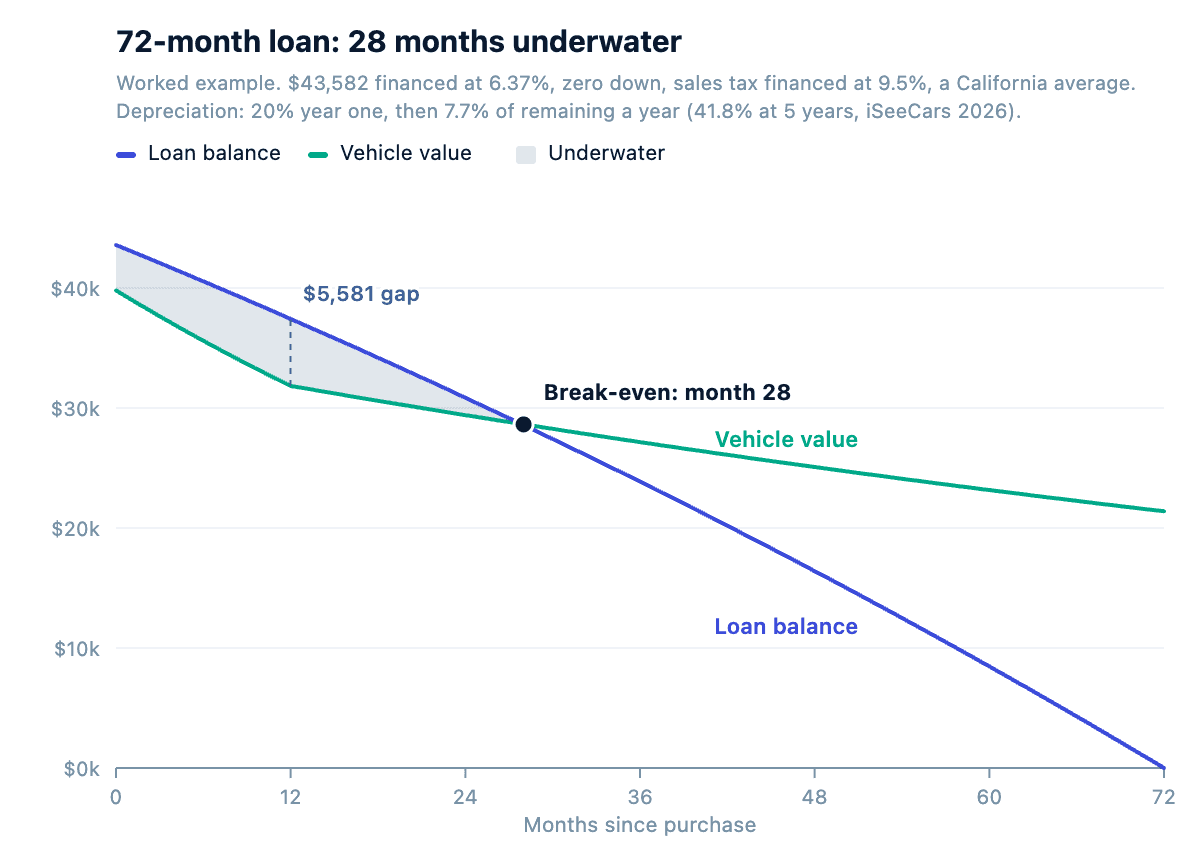
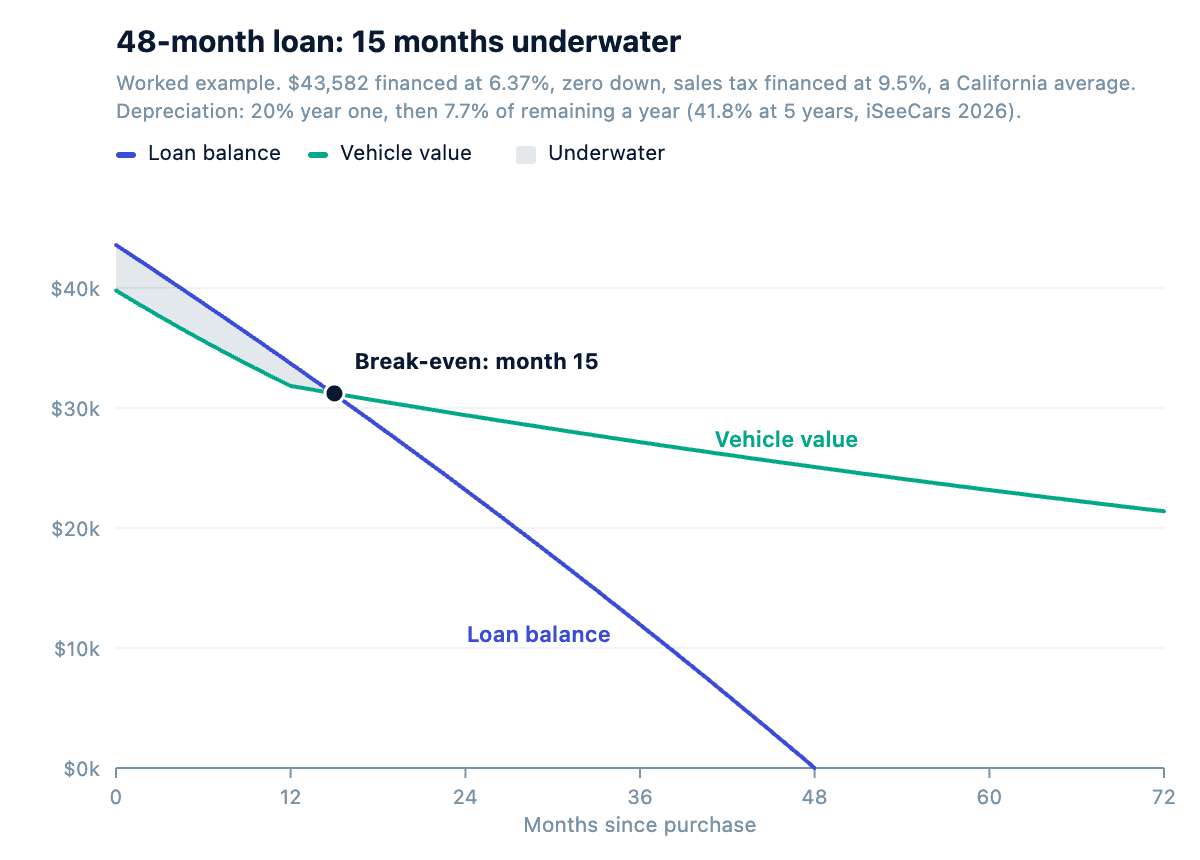
That last point is worth sitting with. On the shorter term, the maximum exposure is the financed sales tax and nothing else. The buyer is behind by exactly the amount of tax rolled into the loan, on day one, and it improves from there. On the longer term the gap keeps widening for a full year before amortization catches up.
Depreciation modeled at 20% in year one, calibrated to a 41.8% five-year average per iSeeCars’ 2026 depreciation study of more than 950,000 vehicles.
Why this is a newer problem
The auto loan has been getting longer for fifty years.
| Decade | Average new-vehicle loan term |
|---|---|
| 1970s | Roughly 30 to 36 months |
| 1980s | 56.2 months |
| 1990s | 54.6 months |
| 2000s | 61.4 months |
| 2010s | 66.0 months |
| 2020s | 69.5 months |
Sources: Federal Reserve G.19 Consumer Credit through 2016, Experian Q1 2026.
In 1976 the Federal Reserve studied whether 60-month auto loans were a good idea. Their analysts calculated that a borrower on a 60-month loan would remain in negative equity for close to three years, and the captive finance companies of the era, GMAC, Ford Motor Credit, and Chrysler Financial, declined to write them on collateral risk grounds. At the time, loans longer than 48 months were roughly one tenth of one percent of new car lending. The memo is public.
The problem was identified fifty years ago. What changed is not the math.
The part that makes the extension defensible
Cars genuinely last longer now. According to S&P Global Mobility, the average age of a light vehicle on American roads was 5.7 years in 1970. In 2024 it reached a record 12.6 years. A vehicle that would have been considered finished at 100,000 miles in 1980 is now at midlife.
So a longer loan is not absurd on its face. The car will outlast the note. That is a real engineering achievement and it is a legitimate argument for financing over a longer horizon.
The question is who received the benefit.
If durability doubled and terms had held, buyers would spend years driving a paid-off vehicle. Instead the term stretched to match the improvement, and the payment-free years went to servicing principal on a more expensive car.
The part almost nobody knows they are paying for
Federal Reserve research found that roughly 70% of auto loans are paid off at least six months ahead of maturity, through trade-in, refinancing, or early payoff. Loans with terms beyond 72 months carry interest rates averaging 2.4 percentage points higher than loans of 36 months or less.
Most borrowers select a longer term for the payment, then leave the loan early anyway, having paid a premium for duration they never used.
Research from the National Bureau of Economic Research found that demand in the auto loan market is considerably more sensitive to loan maturity than to interest rate. Buyers negotiate the payment. Very few negotiate the term.
What being underwater actually costs
This is no longer a marginal condition.
According to Edmunds, in the second quarter of 2026 the average negative equity on a trade-in was $6,884, and 29.6% of trade-ins applied to a new-vehicle purchase carried negative equity. The prior quarter set the record at $7,183 and 30.9%.
What that costs, per Edmunds:
- New-vehicle loans carrying a negative equity trade-in averaged $944 per month, against an industry average of $777.
- Those buyers are projected to pay $16,270 in total interest over the life of the loan, against $9,811 for the average new-vehicle buyer.
Most people know their payment. Almost nobody knows their total interest.
The Consumer Financial Protection Bureau documents where that leads. When negative equity is financed into a new loan, the average loan-to-value ratio reaches 119.3%, against 88.9% for loans with a positive trade-in. Those borrowers were more than twice as likely to have the account assigned to repossession within two years. The CFPB also found that borrowers financing negative equity averaged 73-month terms, against 67 months for buyers with no trade-in.
This is a timing problem, not a discipline problem
The average age of a trade-in carrying negative equity reached 4.0 years in the second quarter of 2026. That places the original purchase in 2022: inventory shortages, no manufacturer incentives, and transaction prices frequently above MSRP.
People who bought in that market are reaching the steep part of the curve now. They did not make an unusual mistake. They bought a car when they needed one, at the worst available moment.
The same applies to a common piece of advice. Buying used reduces depreciation exposure and does not eliminate it, and paying a premium for low mileage means paying for depreciation the first owner already absorbed, then absorbing more of it. Safer is not the same as safe.
The mileage question, inverted
Buyers weighing whether to lease or buy worry about the mileage cap. It is the single most cited reason people give for not leasing a car.
Your lease agreement states the per-mile charge for going over. Take that number and divide $6,884 by it. At twenty cents a mile, that is roughly 34,000 excess miles. At twenty-five cents, roughly 27,500.
That is the mileage overage equivalent of the average negative equity position on a trade-in today. The cost people plan around is often smaller than the one they do not look at.
Where the loss lands
Leasing does not give you a free exit. Terminating a lease early is expensive, and in some situations it is worse than staying in it.
The difference is not the cost. It is whether the cost persists.
On a loan, a loss at exit becomes principal on the next vehicle. It is financed again, at the new rate, over the new term. You continue paying for a car you no longer own, inside the payment for one you do.
On a lease, a loss at exit is settled and stays behind. Whatever it costs to get out, nothing rolls forward into the next transaction.
That is the distinction the standard comparison misses. Leasing does not win the argument. It gets evaluated on the right question.
What actually happens at the end of a lease
Some of the fear around leasing comes from not knowing how it ends. It is more ordinary than people expect.
At the end of the lease term you have three options. You can return the car, pay any excess mileage or wear charges, and walk. You can buy the car outright at the residual value stated in the lease agreement when you signed. Or you can often extend month to month while you decide, depending on the lender.
That second option is worth understanding, because it is the part most people do not know they have. The residual is set at signing. If the market has been kind to your model, the car may be worth more than the residual, and buying it out becomes a good transaction. If the market has been unkind, you hand back the keys and the leasing company absorbs the difference.
Two other practical points. Insuring a leased car is usually slightly more expensive, because lenders require higher liability limits and gap coverage. And leasing generally requires stronger credit than financing does. Lenders weigh your credit score more heavily on a lease approval than on a loan, which for some buyers settles the question before any of the above applies.
Why Dave Ramsey says never to lease
The most widely repeated argument against leasing is that it is the most expensive way to operate a vehicle. On his own terms, that argument is correct.
Ramsey’s advice is built for a specific plan: buy a used car outright, keep it a decade, never carry a car payment. Measured against that plan, leasing loses badly and so does financing a new car. He is not comparing lease to loan. He is comparing both to not borrowing.
If that is your plan, follow it. It is the strongest financial position available in this entire discussion.
The argument does not transfer as cleanly to someone who is going to have a car payment either way. For a buyer replacing a vehicle every three or four years, the comparison is not lease versus paid-off-Corolla. It is lease versus a loan they will exit before it amortizes, carrying whatever gap remains into the next one. That is a different question, and the answer to it is not automatic.
The comparison that matters
| Lease | Finance | |
|---|---|---|
| Who carries depreciation risk | The lender, at a residual value set at signing | You, at whatever the market pays later |
| Who carries repair risk during the term | Largely the manufacturer, within warranty | You, once the warranty ends |
| What happens to a loss at exit | Settled and left behind | Becomes principal on the next loan |
| What the exit price is | Known at signing | Unknown until you sell |
| Cost of an unplanned early exit | High, and stated in the contract | High, and paid as carried negative equity |
| Mileage | Capped, with a stated per-mile charge | Unlimited, priced into resale value |
| Who it suits | An uncertain hold period | A long hold, high mileage, or modifications |
When financing is clearly the right answer
For a large share of buyers, it is.
You keep cars a long time. The equity accumulates slowly and then it is yours. Years of driving a paid-off vehicle is the strongest financial argument in this entire discussion, and it belongs to buyers, not lessees.
You drive a lot. Well above 15,000 miles a year and the arithmetic above reverses.
You modify vehicles. Anything not easily reversible creates a problem at lease return.
Leasing is not available to you. Lease approval generally requires a stronger credit score than financing does. For some buyers this is a constraint rather than a preference, and no comparison table changes that.
Sometimes the answer is neither
If you are underwater and the vehicle you have still works, waiting is often the strongest move available. Two more years moves you past the steepest part of depreciation and into the portion of the amortization schedule where payments meaningfully reduce principal. The two curves stop working against each other.
That is not advice everyone can take. Needs change, and sometimes the change is not optional. A family outgrows a vehicle. A job moves across the country. Those are real and they do not wait for an amortization schedule.
But it is a genuine option, and it is absent from almost every comparison of this decision, for a structural reason: most of the sites publishing those comparisons are compensated when a transaction happens.
Who has an obligation to tell you not to buy
A licensed auto broker does. In California, a broker arranging a retail sale owes a fiduciary duty of utmost care, integrity, honesty, and loyalty to the party it represents, under Vehicle Code Section 11735(e). That obligation runs to the client, not to the transaction.
A dealership salesperson is compensated on the sale. A comparison site is compensated on the loan referral. Neither is doing anything wrong, but neither has a duty that survives you deciding to keep your current car. A broker’s does.
In practice it means the recommendation is sometimes to wait, and sometimes to buy the vehicle you were going to buy anyway without any help. Representation that only points one direction is not representation.
The bottom line
Neither structure is better. They allocate risk differently, and the right one depends on how confident you are about when you will exit and what you want to happen to the loss when you do.
If you are working through this for a specific vehicle, model both with your actual numbers: your mileage, your tax rate, the money factor and residual on the car you are considering, and the real cost of covering mechanical risk if the loan runs past the warranty. That exercise produces a clearer answer than any general guidance, including this.
For how California’s tax structure changes this arithmetic specifically, see Lease vs. Buy in California.
If you would like to work through the comparison for a specific vehicle, schedule a consultation. There is no inventory we are trying to move.
CarOracle® is a California licensed motor vehicle dealer with an autobroker’s endorsement, License No. 43082, serving clients throughout California.